Friday, August 31, 2012

Don't Let the Door Hit You on the Way Out


There's a book up on the shelf about the dust bowl days
And there's a little bit of you and a little bit of me

In the photos on every page.....nancy griffith

To say that Care and Concern have been constant companions would not be an overstatement.   We all talk a good game, keeping the proverbial stiff upper lip, Are we not the psychological godchildren of American Gothic?  In an ordinary year, we  are the repressive thin lipped spirits of an eleventh commandment beloved of second grade teachers: 'thou shalt have no fun"...before me or after I leave or while my back is turned.   In a voting year, we are caricatures for the media and opinion makers.We take the future seriously; we answer the phones for pollsters. We are likely voters.
But in a drought year, a disaster year, that back bone, that set chin, that 'knuckle down, buckle down, do it, do it, do it' spirit is sum and substance heroic.  American Gothic small town small mindedness morphs magically into the fortitude of our forefathers. All our faults are in our favor. Without the innate recognition that 'man is born to trouble as the sparks fly upward,' we couldn't ruefully, humorously sport bumper stickers that proclaim S*** Happens....with a smiley face.  

Have you seen the folks in line downtown at the station
They're all buying their ticket out and talking the great depression
Our parents had their hard times fifty years ago
When they stood out in these empty fields in dust as deep as snow....nancy griffith
   
That Dust Bowl generation is passing on; those tough, yearning thin faces of survival, famously photographed on roadsides and door steps, refugees, but not quitters, who took the hard step of leaving homes,land. and livelihood, who left even hope behind, but persevered finally to tell the tale and plant their roots so their children could have children and tell the tales and plant the signs for their Century Farms.   
Now our children live in the city and they rest upon our shoulders
They never want the rain to fall or the weather to get colder...

No doubt we farmers have lost much of the sympathy vote from our neighbors in the city.  Climate controlled machinery and the latest in electronics; auto pilot, technologically manipulated seed and the insistence that we are intelligent businessmen, JUST LIKE THEY ARE, have pushed the ancestral fear of famine and shortages back into the caves from which we emerged.  Heaping glories of juicy fruits, crisp and peppery greens, mouth watering meats and fragrant breads line aisles of  giant food emporiums.......or farmers' markets for those with the smaller is better predilection.  They are always there; the shelves are always full.  Who sits down and ponders the past while they choose which coffee they will grind and brew for their morning cup?  Farmers do.  Believe me, in years of drought, our morning commute is Chinese water torture in reverse; watching the color drain from the landscape until the ground, the sky, the leaves, the grass, and the crops are the self same washed out hue of 80 year old photographs.  People food may be abundant in the stores, but when the fields are bare and the ponds dry, life is a struggle for livestock.  Modern day agriculture can mitigate but cannot abolish shortages of hay, grain, water.  


And all this trouble in our fields
If this rain can fall, these wounds can heal
They'll never take our native soil......nanci griffith


Our native soil has been cracked since May.  The corn manned up and stood tall through more of July than we could have imagined.  No more.  No healthy gold of stalks that matured in season; the rows are battered brown or even more devastating blackened stubs more reminiscent of burned over forest than amber waves of grain.  Indeed, this season of wildfires out West is well matched to the wavering heat waves hovering over our barren fields.  But our soil is at home, bound by ties of last year's roots, ready and waiting to absorb the saving rain.  Our dust bowl is reduced to the rime of lime from our gravel road. Try as it might, the wind can suck the moisture from man and beast...but our irreplaceable soil, our dowry, our retirement, our annuity, our true Social Security, stays put. 

When the rains finally fall....and they will......the fields will heal. 
And we will commit this dreadful season to memory....and our own Dust Bin of History.

Wednesday, August 22, 2012

Most Happy Fella


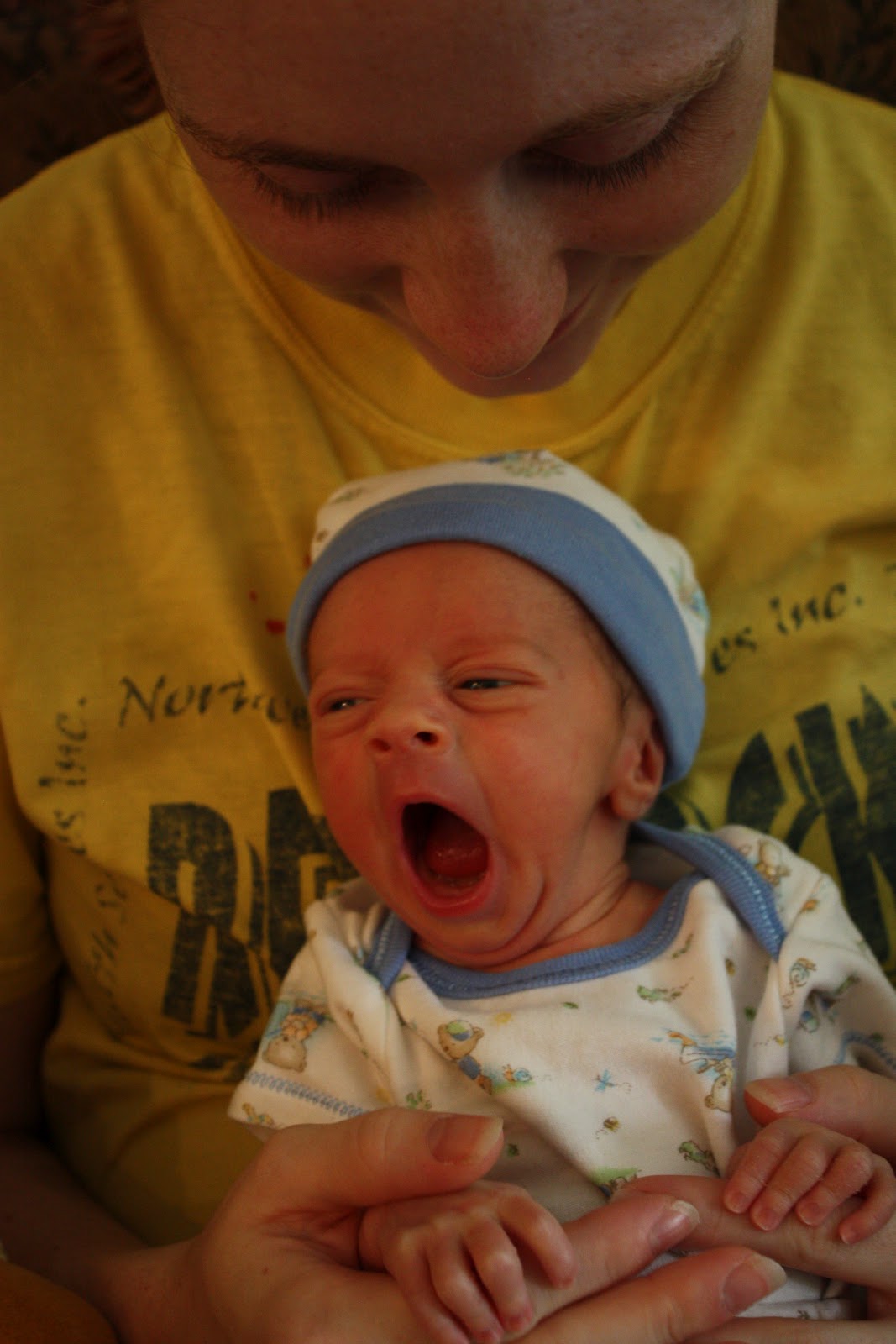
His daddy says there are over three hundred pictures already.  He is ten days old.  Do the math.


He had his first bath today, slung in a hammock over the kitchen sink with a parent at each end. 
He slept in his new bed last night for the first time, somehow, mysteriously, moving closer and closer to his mama's side as morning drew nigh.  If you are Levi, there are so many firsts to look forward to.

I still clearly remember the first day home with a new baby.  All the freebie giveaways from the hospital in quantities too small to be really useful.  The deflating balloons.  The flowers that are worse for the trip propped against a bag of dirty pregnant clothes.  The general level of untidiness exuded by a house emptied in haste.


But last evening  was a flashback to the other marvelous aspect of that first day home with a new baby: the ineffable sense of completeness that envelops everyone in the house, whether mommy, daddy, or siblings. One explanation could be simple exhaustion, true enough.  But I always thought our house felt fuller, as if happiness had mass and took up space, meeting the classical definition of matter.  More than dirty diapers and pack 'n plays, more than the myriad other physical manifestations, so out of proportion with the size of their proprietor, this almost visible satisfaction is one demonstration on earth of heavenly peace.  In one hour, or two, the old Adam will rear his head with squalling and other less appealing evidence of fallen humanity.  But for now, God is in His heaven and all is right with the world....


Thursday, August 16, 2012

Seventh Floor

Its the land of little tiny people, of blinking lights and buzzers, where caregivers with deft hands and experienced eyes and ears watch their charges, attuned by a sense deeper than technology to the vagaries and changes in the very small humans sleeping under blankets, or lights, or only miniature Huggies.  Mommies and daddies come to visit, to rock, to feed, to rejoice over poopy diapers, and to hope.  New babies are most beautiful to those closest to them; in no time at all, the moniters, tubes and tape become invisible and your baby's eyes, tiny hands, ears, chin and nose are absolutely identifiable with some family member.  Thus do we create the ties that bind.

Life is most elemental here and desires are few.  The little boys and girls need to be warm, and full, and be able to take deep breaths on their own.  What should be easy is not always so.  There is rejoicing each time a tiny goal is met by a tiny person. There is ongoing affirmation of our common humanity and a constant reminder of Jesus' words in Matthew: ' Inasmuch as ye have done it unto one of the least of these my brethren, ye have done it unto me.'  As these little children are, so were we.  We have been as helpless, as hurting; we have struggled against odds and with hope.  We need all the aid, all the prayers, all the loving hands, all the healing, to grow.  The touching, hands on care, sacrifice and dedication for these tiny ones is a breath taking reminder of the immanent love of our Savior.  


Thursday, July 26, 2012

The Letters P & H


Today's episode is brought to you by the letter  P and the letter H.   Why do we need the letters P and H?  H is a real easy one: easy to spell, easy to guess, but Hard to  endure.  H is for HEAT,  the watchword and defining element of this long difficult season.  HOT says Josh, pointing to my coffee cup or a saucepan on the gas range.  HOT is more than a feeling this summer; its a palpable substance that meets you through the door, batters you on the breeze and drains both energy and optimism from the sweat of your brow.

Great works are performed not by strength but by perseverance............Samuel Johnson

That's why we celebrate the letter P.  P today is for Perseverance.  A long involved word of  multiple vowels with all the positives of persistence without the opprobrium of obstinacy.  A word with armor, shielded and immovable like a tortoise.  The kind of word one needs this summer, when each day is like its brother: bright, hard, shiny, brittle.  Fight fire with fire....102?  104?  Add a southwest wind?  I'll show you my perseverance, pull my hat brim down and pour a bigger glass of tea.  When all else fails, show bravado.


OK.  Maybe bravado isn't the most admirable of traits.  But if it raise the spirits, there are worse ones.

Don Quixote: A knight must not complain of his wounds, though his bowels be dropping out.

Here in farming country there has been remarkably little whining this dry season.  We've found our stiff upper lips,  if not our senses of humor.  Misery may love company, but we  look back to our parents and grandparents and find our strength in their character.  Those tales resonate; we have the photographs, the statistics, and even some of the storytellers still around to stiffen our backbones and lift our chins.  These are the days of which legends are made and ties are bound.  We are FAMILY; we have common cause; we survived, if not thrived, in the summer of 2012.


Romans 5:3-4   Not only so, but we also rejoice in our sufferings, because we know that suffering produces perseverance; perseverance, character; and character, hope


And that brings me back to the letter H.  H is not just for Hotter that H***.  St. Paul tells us hope is the natural harvest of our character.  As sure as the seasons, hope ripens from our character after perseverance follows suffering, a reassuring organic progression.  Just as lovely is Emily Dickinson's verse, one nurtured and polished in my memory like a gleaming gem.  Hope flutters, it shrugs off trouble like an unpleasant dream; it gathers itself and greets adversity with wordless song. When we are burdened  beyond bearing with no recourse in sight, we listen inside for the song of hope planted there by our Creator.   

“Hope” is the thing with feathers -
That perches in the soul -
And sings the tune without the words -
And never stops - at all -.........Emily Dickinson


Tonight we looked to the sky where clouds blossomed and thunder rolled.  Tonight we listened and watched as rain drove the yellowed leaves from the sycamores and cars splashed through new puddles.  It wasn't a drought buster; it wasn't relief; it wasn't enough to unfurl leaves or green grass.

But it was the personification of Hope.


This post is dedicated to family and loved ones who demonstrate to us the best of perseverance and hope.  

Monday, July 16, 2012

Dry County

I turn the sprinkler off just about the time the blister that is  the sun melts down behind the trees.  I'm rescuing the hostas under the sycamores and I stand for a few minutes just to hear the drops fall off the overhead leaves.  That's what a rain would sound like.

In the middle of the night, the air conditioner comes on in our bedroom.  Its soft whooshing through the vent wakes me and I think, half asleep, that it sounds like rain on the windows.

  This is what happens when you live in a dry county.

An early spring, a dry spring, does not necessarily lead to a dry summer: this is what the meteorologists told us again and again as the daffodils and crab apples bloomed before Easter and the peonies were drooping by Mother's Day.  Heat shut the door on spring and spoiled the first evenings with fireflies.  Those leisurely strolls and bike rides around the neighborhoods became races to beat the sunrise.

The corn was planted in record time by a record date.  Nothing to do but plant the beans shallow and hope a passing shower brought them up out of the dust.  Farmers run on hope and prayers, whatever the forecasters say.    Corn grows on its own internal computer, following the inexorable timetable of  its breeding.  'First the blade, then the ear, then the full corn shall appear', as the hymn proclaims.  Corn doesn't stick its tassel out and look for its shadow like the groundhog.  Corn says, damn the torpedoes, full speed ahead!  Our corn has been worthy of its expensive pedigree, remaining green and pretty long after topsoil moisture was gone, two and a half weeks after the last half inch rain.  Tassels emerged and pollen shed over the Fourth of July, the 5th and the 6th with temperatures of 100, 100,  and 102. We know what happened in 2011 when it was 100 degrees and wet.  We didn't talk about what might happen when the corn field is three digits and dry.  We are farmers.  Damn the torpedoes, its Independence Day; we shot our fireworks anyway.

Be realistic.  We live in the western Corn Belt. We were married in a drought year...1977.   In the 80s we suffered three droughts.  Four, if you count 1980 itself.  In the 2001 and 2002, we pumped the well dry for the first time  in March and hauled water for our greenhouse crops every day until September when we sold them.  The rains came in October.  We haven't had a crop failure due to drought since then.  Our land isn't worth $10,000 an acre for a reason.  And that reason is rain.

Be philosophical.  We are not alone in this one.  The land is dry everywhere in our state.  The land is dry, I hear tell, even in Illinois and much of Iowa.  The markets tell us so.

Be grateful.  Our wells are holding up.  We can still water the mums and the gardens.  We can still keep something pretty around us.  After a while, you have to develop tunnel vision.  Drive down the road looking neither left nor right at the crops turning white and the trees turning brown.  Summer does end and rain will fall.  Dust will settle.

Then we'll all toast the end of this dry county.


Saturday, July 14, 2012

Corn, Corn, Corn....

It is a substantial structure, now a century old, still in use, still surrounded by gates and a corral. The overhanging eaves shelter some of the old but well maintained equipment of its owner.  Upstairs, in a the hay loft, stands a ping pong table, just the most recent incarnation of the big red barn.  We celebrated the centennial of the red barn just last month with grilled pork, cake, baseball, kids, dogs and an giant RV in the driveway.  We honored tradition and longevity, epitomized by the big red barn and the generations of the family choosing to celebrate a building.


According to Wikipedia, barn raisings were common enough community affairs more than a century ago, but had pretty well been replaced by hired crews and commercial construction by the time my folks' 1912 barn was built.  Nonetheless, it could still be a illustration for a children's book featuring a barn raising:  post and beam, massive hay loft, shiny metal gambrel roof and classic red barn paint job. Years past, my sister and I both took turns climbing the tall ladder to paint the gable end of the barn; my father gave my mother untold nervous head aches stringing ladders across the roof to repair loose tin and repaint any stealthy incipient creeping rust invisible from the ground but sensed by my father's ultra sensitive preservation antennae. The tall ladder is retired now; a crew of Mennonites contracted to keep the roof silver last time around.


While barn raisings are an "example of a fundamental form of human cooperation" -, the extensive community of Hursts got together this week for another type of rural ritual: putting up sweet corn.      My parents' farm garden had three or four long rows of sweet corn, protected by a thin electrified wire from things that go bump in the night and have unerring instincts for juicy kernels.  But our family sweet corn patch is on a different scale completely, sown by a sixteen row planter and surrounded by rows and rows of field corn.  This much corn demands a battle plan.


The driveway is crowded when I pull in; the number of pickups a dead giveaway that sweet corn is more than woman's work.  A truck wide swath is mowed into the corn patch; the men pull the ears, then shuck them in the field. Corn fields in July are steamy stifling places; now a half dozen lawn chairs form a semicircle around the corn laden pickup parked under a shade tree.  Farmers with dish towels wipe the silks from the ears, bringing canners, roasters, wash baskets full of shucked and dewormed ears to the house. Tall glasses of iced tea perch on the grass, all sticky from the sugary ears. 


The canning kitchen downstairs spouts steam like a geyser field in Yellowstone and rattles like a 110 car unit train going over a bridge.  Two canners 'double double toil and trouble' like Shakespeare's witches. Two sinks brim with cold water, ready to catch the steaming ears and cool them enough to cut.  The stovetop is charred with carmelized corn juice.  There is a rhythm to this job.  Boil the water; feed the ears into the canner cautiously, dodging the boiling spray.  When one pot comes to a rolling boil, shift the ears with tongs one by one to the sink of cool water.  Check the other canner.  Move cooler ears to even colder water.  Fill the canner with more ears. Pull the corn from the second boiling canner.  Fill a pan with cooler ears.  Fill the sink with hot ears.  Sound complicated?  Not really.  There is a rhythm.  


In the garage, long plastic tables hold an assortment of knives, Pyrex, freezer bags and broiler pans.  Each time a pan of blanched corn emerges from the basement, we grab a handful of ears.  Knife choice is a matter of individual taste; some prefer a fisherman's fillet knife; some bring a well protected chef's knife; some...like me....choose the cheapest sort of paring knife..a long ago giveaway from Pioneer seed corn.  This is tradition, the same sort of knife I have been cutting vegetables with for thirty some years.  The knife we looked forward to getting every winter after we ordered our Pioneer seed corn from the dealer.  No other giveaway has ever matched up to a short paring knife, soft enough to sharpen with a hand held, hard enough to cut cleanly through the soft juicy kernels.  Cheap enough to lose in the trash and not break your heart.


Chicka-chicka-chicka go the knives down the ears and the pale pearly kernels accumulate in the Pyrex. Thunk! We throw our cobs into a 55 gallon trash can.  In intervals between pans of ears, we scoop corn into quart or pint size freezer bags, dependent upon family size.  Some years we freeze too much...in a dry year like this one, the ears are petite and the kernels shallow.  We will run out of corn before next year's crop comes on.  There are many of us....while the women stand in assembly line formation, children of all sizes and usefulness come and go.  The bigger ones float between cuttings and silking and watching the littler ones with no sense.  The littler ones want to help cut...of course...but we send them outdoors to the silking crew...far away from sharp and potentially harmful objects.  Aaron and Gus are old enough to be useful and proud enough of that fact to want to help.  They go to the field to fetch more corn....they carry ears back and forth from the basement....they finally succumb to the irresistible urge to ride the 4 wheeler.  They are good boys and we give them verbal pats on the back.


I cannot participate in this yearly ceremony without the past coming back to stand across the table.  This day I visit and gossip or work in companionable silence with my daughters.  We are bound by ties more various than mere blood and relation;  we walk in the footsteps of our predecessors.  I could just as easily be standing in Millie's old kitchen, wallpapered, linoleumed, walnut cabinets, with a rangetop view of the family room, the floor so sticky and the humidity clinging to the formica table top.  Those could be my girls rough housing with their cousins, building "tents" in the front room from couch cushions and afghans, their screams, laughter, and arguments masked by the roar of boiling water.  I can see Grandma Eunice across that table.  She defies safety and convention by cutting the ears toward her.  Her ears are perfectly square, not a kernel left behind, no frizz, no waste.  She uses a Tupperware measuring cup to scoop the corn into bags.  She huffs with effort and rests between pans.  It could be yesterday...not twenty five years ago.   


Sweet corn in season is ephemeral; like God's manna, you cannot save it for another day.  "Just picked" is a different country than 'fresh'.  But the lovely yearly ritual with its ageless patterns of teamwork and responsibility, its consistency, its predictability, is more than enough reward, wintry treats aside.  Every time I chisel a quart bag from its brothers, I partake in more than a side dish to a meal...I cook my past, present and future.

Wednesday, July 4, 2012

Oh! You Beautiful!


O beautiful for pilgrim feet 
Whose stern impassioned stress


A thoroughfare of freedom beat 

Across the wilderness! 


America! America! 

God mend thine every flaw, 


Confirm thy soul in self-control, 
Thy liberty in law!


O beautiful for heroes proved 

In liberating strife. 

Who more than self their country loved
And mercy more than life! 


America!America! 

May God thy gold refine 
Till all success be nobleness 
And every gain divine! 


O beautiful for patriot dream 
That sees beyond the years 
Thine alabaster cities gleam 
Undimmed by human tears! 


America! America! 
God shed his grace on thee 

And crown thy good with brotherhood 

From sea to shining sea!