Showing posts with label #homestead. Show all posts

Wednesday, April 12, 2017

Flowers of the Field


The stove is in the garage; the fridge is on the back porch; the microwave perches on a church pew.  The coffeepot still lives, parked on a plastic Rubbermaid tub with two plaster dusted mugs and a box of Starbucks pods alongside.  Our kitchen, always the heart of our house, is down to bare bones.


Forty years ago, my mother and father sold their land in Calloway county and bought a property with a limestone creek, a gabled barn, a milking parlor, some pasture ground and a couple of fields planted to milo. They had a vision and over the years they realized their plan, seeding the upland field to warm season prairie grasses, building ponds, and fences, and facilities in and around the big barn for handling cattle and storing hay.  The milo fields became a pasture, and an orchard.  The rundown outbuildings were painted red and roofed in silver, jacked up and leveled and put to use.  There was a bountiful garden with soil mellowed by well aged manure carted up a wheelbarrow at a time from the red barn floor.  Over time the rambling old home was remodeled; two greenhouses spoke to the resident green thumbs; a swing set was built for grandchildren and a telescope turned the former milking parlor into a planetarium.  Summertime and wintertime:  holidays and harvests: the farmstead was a lovely busy fruitful place.
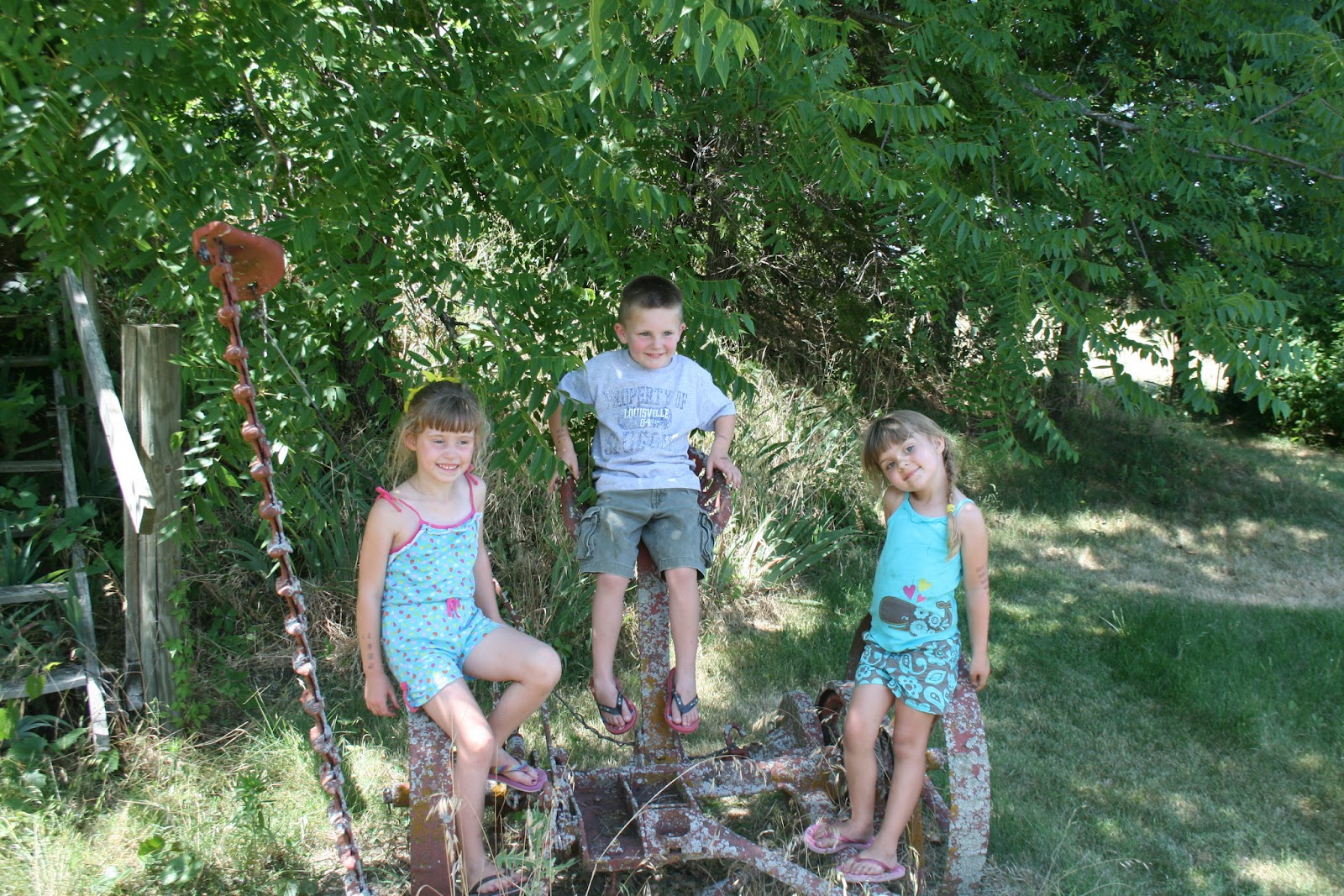


But neither a house, nor a farm, really makes a home.  The couple who lovingly restored and improved and transformed the worn out ground and aged house are worn and aged themselves.  The gardens have gradually shrunk and the apple trees are bent and broken.  The place is still lovely; the pastures with well fed cattle, the grasslands without sprouts, the ponds fenced, the little trees planted decades ago now mature.  But there is an air of emptiness this spring as the daffodils bloom unnoticed and the early opportunistic weeds spring up unabated.

As a gardener I know only too well how quickly our most strenuous efforts at taming the land to our wishes can vanish.  It is a visual manifestation of the Biblical klaxon, a warning that:


15 As for man, his days are like grass;
         As a flower of the field, so he flourishes.

16When the wind has passed over it, it is no more,
         And its place acknowledges it no longer. 
(Psalm 103:15-16)


....or

For, "All people are like grass, and all their glory is like the flowers of the field; 
the grass withers and the flowers fall,
(1 Peter 1:24)
  

Our works, our beauty, our efforts...ephemera. 

But... that is not all...  

To paraphrase St. Paul, " I will show you a still more excellent way...." (1 Corinthians 12:31)

In a desk drawer upstairs is a packet of letters tied with black twine addressed to a midshipman in the Navy from a young woman at Greenberry Road.  The bundle of letters has made many moves: from Jefferson City to Columbia to Chicago back to a farmhouse attic in Calloway county to an antique dresser on the other side of the Missouri and now safely stowed in a desk my mother's father made out of hard rock maple.  I haven't unwound the twine string, but the survival of these letters after more than a half century and many more miles attests more loudly than any words to ties that bind.

When memories fail and words won't come, but she looks for him every day; when they hold hands while watching Wheel of Fortune each evening; when my father and mother still kiss good night; these are the times I catch a glimpse of the more excellent way, a merest hint of the eternal within the mortal, a reminder of the next chapter, 1 Corinthians 13: 

 4Love is patient, love is kind and is not jealous; love does not brag and is not arrogant, 5does not act unbecomingly; it does not seek its own, is not provoked, does not take into account a wrong suffered, 6does not rejoice in unrighteousness, but rejoices with the truth; 7bears all things, believes all things, hopes all things, endures all things.

 These two people are not perfect, not always patient and kind, at times provoked, but they are faithful. They care for each other....even when they cannot care for themselves. This and every other long marriage testifies that love bears much and endures all.  Gardens lie fallow and houses stand empty; bodies become fragile and break.....


"for now we see in a mirror dimly...but then face to face." 

 It's a promise.


Tuesday, November 10, 2015

Prairie Perspective


Beach or lake? ....This is a parlor game we play when we are deep into the second month of harvest and plunging through the waves of an ocean of  grain. Where would we rather be? Enjoying the quiet banks of a tree rimmed lake up north or the constant music of the ocean running back and forth over the sands. We have spent pleasant hours in reading and reflection next to water; to revisit these settings in our minds and contemplate their delights is a companionable way to while the hours away.  Beach or lake?  Idle chatter of a prairie schooner, pipe dream of the landlocked.
I plead guilty to this kind of over-the-rainbow-pie-in-the-sky-view-finding. Especially in moments of weakness...or days when the wind blows over 30 mph.  But not when the sun's rays slant low and golden, casting long and deep spider web shadows of barbed wire fences...or electric lines...or windmills.
Then I take issue with those who castigate our surroundings as uninteresting, or dismiss them as man-made and artificial. We may rightly stand in awe of extreme landscapes, exceptional, one of a kind and incomparable.  But we ordinary folk don't live in places like that.  We cannot fully appreciate the landscape around us unless we not only accept, but also appreciate, the role we humans play in its order and rhythm and, yes, beauty.

On a fall day day in November when the fields have donned their harvest hues of dun and buff and weathered gray, I think the view from the hill behind the greenhouses is much what Lewis and Clark would have seen, had they been camping in Atchison county in late fall: smooth and rounded hills within a level horizon, creek banks marked by dark creases of trees and covered by a great stage of a sky, maybe gray and hovering close, maybe impossibly blue and distant.
From my hilltop, I can see the pageant of farm work proceed with the seasons.  The desolation of winter is broken only by the dark patches where cattle are fed and the graffiti of wildlife tracks.  Spring is a brown season...we often have three brown seasons up here, you know.  The wild trees venture faint bloom and leaf by May, but the green of new crops above the no till stubble won't be visible from a distance before Mother's Day most years.  Nature's calendar rules; the native warm season grasses linger in their weary clumps until the sun raises them up with warmth.
 Familiarity does not breed contempt. A volatile and unpredictable climate breeds a citizenry that wears the inhospitable nature of its chosen home as a badge of honor.  Who needs a wilderness when the weather itself is a raging beast? The domesticity of the Corn Belt is part of its attraction. An orderly landscape of crops tracing the topographical contours, the 90 degree precision of east-west, north-south section roads, the geometry of grain bins and augers, all suggest the virtuous productivity of the people and their partnership with the land.  The treasure of this place lies underground and the service of man to fellow man is in the cultivation and harvest of soil and production of grain in a place especially suited for the purpose.

The emigrants of Oregon Trail days bypassed this piece of prairie in search of a more hospitable clime across the mountains.  The folks that settled our hills, planting crops and orchards, building homes and fences, churches, cemeteries, and schools were justifiably proud of their industry, equated civilization with progress, and published their accomplishments for all of posterity to appreciate.

Periodically the movers and shakers far away take a look at the middle of the country, our American "Empty Quarter",
and lob long distance pot shots at how we think, what we believe, and what we do. They should peruse their own community's Biographical History and learn to appreciate the pride those who built the small towns and settled the counties took in their barns and homes, the Poland China hogs and  Buff Cochin chickens, their businesses, their politics, and their churches.


We can't offer much in the line of beaches...and our vistas are short on drama.  But this place abounds in a different quality...that of rootedness.  Human effort, persistence, and adaptability have given us a view we can appreciate for its history and hope for our future.


We can visit the beach anytime...

That's my prairie perspective....


Thursday, August 27, 2015

It's a Dog's Life

There's Skaggs...gray muzzled and shaggy, slow to rise, memorialized forever on a snowy trail in the Missouri woods by my mother's paintbrush.  And Nip and Tuck, gargantuan leaping licking Labs, terrifyingly huge as they clawed the back door of our 1960s Dodge Darts.  In their puppyish exuberance, they could and would knock over small children. These were the first dogs I remember, the dogs that met us in the driveway of Granny and Grandpa's country home.

Patty was Uncle Dean's dog, a speckled Pointer who patrolled her yard tirelessly, eyeing us like possible prey with her watchful restless golden eye.  I knew nothing of hunting dogs, but read Dean's library of hunting and fishing books voraciously, developing a healthy respect for the diligence and instincts of bird dogs.
We were petless when we moved from Chicago to the farm in Calloway county until Grafin came along.  She was just a pup, part collie and whatever else.  She had tender liquid brown eyes and an amazing fur coat.  When happy, she was all pink tongue and wag.  Laura and I showered her with attention, but, like kids will, she flourished under the rules and discipline of my father, sitting, staying and coming when called.  All dogs loved my mother, sensing, no doubt, the inner sweetness of spirit she possesses.  Unlike the neighbor's fierce and frightening German Shepherds, Grafin was a gentle spirit, a companionable presence, a welcoming committee to visitors.  She was the farm dog from  my high school years, college, and a move to a new farm yard and garden in Moniteau county.  There, thinner under all that fur and white up to her eyes, she would still bestir herself to come up to the car and meet two more young girls, Lee and Ann.  Some time before she passed, my folks brought two new puppies into the fold, Maggie and Maud.  One of our very favorite photos shows a very young Lee in a summery outfit of t shirt and Pampers, bending down to give Maudie a smooch.  I don't think I am stretching when I describe Maud's expression as beatific.
By that time, our family had a dog of our very own.  Our first doggie was an adoptee we saw on the evening newscast in Columbia while we were just married and still in college.  We weren't looking for a dog, but the puppies described as part Doberman and part German Shepherd somehow grabbed our attention and Juno, just a little thing, nearly all black with a tail that threatened to absolutely wag the dog, stole our hearts.  Every weekend that spring, she traveled back and forth from Columbia to northwest Missouri where we worked on our little rental house instead of farming that rainy rainy spring.  She curled up quietly on the floor behind the driver's seat and spent most of the trip snoozing.  The neighbor's dog would terrorize her if we left her tied up at the duplex in Columbia, so, she joined up indoors during the week, always a lady. Soon, she had no need for that dispensation, growing long tan legs and the stature of her forebears.

Juno thought of herself as a farmhand, not a farm dog.  She left with Blake every morning, whether that meant riding alongside him in the pickup or atop the tool box in the back.  Most days she'd run in front of whatever implement he was driving....a tractor cultivating corn or disking stalk ground.  Harvest time would find her waiting patiently in the truck cab or even the cab of the tractor running the unloading auger.  The best days in dog-dom were spent tirelessly chasing whatever critters were scared up by the combine....rabbits, mice, pheasants, or those little whirring gray birds you only see after dark in the combine lights.  We'd always wonder if she'd take a day off after those long evenings, but first thing in the morning, Juno would be ready and waiting to leap up into the cab when Blake opened the door.


Our farm attracted dogs like a picnic does ants.  Word somehow got out on the canine network that any abandoned, lost, or dumped dog with a friendly aspect and a sad story would be fed and patted and not run off by the dogs already in residence.  A family of four...and then five...soon had a commensurate number of dogs swarming the front door when they heard us stirring, meeting the bus when kids got on in the morning and off in the afternoon.  Dogs with all matter of idiosyncrasies and foibles called our wide open spaces home....Tommy and Holly drove me to distraction as puppies, un-digging new roses, shrubs, and perennials with which I attempted to civilize the barren yard.  I could only hope Lee and Ann did not understand the epithets I screamed at the uncomprehending puppies as I chased them through the yard with some desiccated plant body.  Frisky was a beautiful black dog, sleek and affectionate, but with an insatiable desire to drag clothes off the line.  Mister was another stranger that made himself at home off the street: he was too well mannered to jump on us, but the kids loved to lift his paws so he would 'dance' with them.  Bob was big all over, with a giant head and soulful eyes.  He was smart, friendly, and knew enough tricks that we were certain someone would come looking for him. To our combined delight and concern, Bob outdid himself at the 4th of July, pursuing lighted fireworks of all sizes and ferocity and attempting to fetch them.  When other dogs were AWOL under the porch, we had no choice but to confine Bob for his own safety.


The downside of a  farm dog's life is its danger.  The listing of beloved animals that fell prey to trailer and truck tires by accident or sheer wanton stupidity is long and sad and reads like the lyrics of a Lyle Lovett song:


Now there was great Uncle Julius
And there was Aunt Annie Mueller
And Mary and granddaddy Paul
And there was Hanna and Ella
And Alvin and Alec and he owned his own funeral hall


And there are more I remember
And more I could mention
Than words I could write in a song
But I feel them watching and I see them laughing
And I hear them singing along


Indeed, our doggy friends come and go, sometimes a brief time, others living out their long warm days under the elms by the back door.  They are as much a part of our landscape as the wind. 

A farm without dogs is missing a piece of its soul......