Showing posts with label #AllAmerican. Show all posts

Tuesday, May 19, 2015

Vanishing Points

Anyone ever tear out the postage paid cards offering free vacation guides and roadmaps for prospective Great American Roadtrippers in the Better Homes and Gardens magazines in the checkout aisle? I was that kid, a sucker for free stuff, for maps, for sights to see and roads not taken. I diligently sent off for every free offer from any state from any magazine my mom subscribed to; magazines at the doctor's or dentist's or car dealer's were also fair game. Never mind that our family trips were predestined: no need for Delaware, Florida, or Maine. The maps themselves had power.
When the Missouri road map arrived, we unfolded to the listing of cities and counties to check the status of a place we had never been, never seen: a site as mythical as Brigadoon in our family lore. The state of Missouri listed every village, every borough, and, I assume, every wide spot off a lettered highway, including our very favorite town, a little place called Bado down in Texas county.

What made Bado special? With a population of just four people, it was the smallest town in the state of Missouri. We were entranced; not only with the notion of a place the size of our family being a town, but the fact that Missouri's highway map would recognize not just cities like St. Louis....but also a town like Bado, so unimaginably small that we figured its buildings must all be empty! The map told us Bado was a place, but it was also an idea, a coming together of the lines of perspective, a myth, a mist, that would disappear if we didn't check on it every year....or if we drove down to Texas county to find it.

Out here on the prairie, the wind, the rain, and time itself join forces to change landscapes until nothing is left but a name. A forgotten rural schoolhouse once stood south and east of Westboro along the gravel road I drive to work. For a while the rubble of bricks turned up at planting time, but the foundation is one with the soil any more.
There are a number of signs along the two miles of route O near the site of the old schoolhouse, put up several years back by a proprietor of Fourteen Pines farm. Alas, a casual traveler can no longer pick out the home place; age and disease have left nothing of the statuesque pines. I have enjoyed the place names on the signs in the fence rows, but they are deteriorating as well and will soon be as much a mystery as the name 'Rosebud' on a sled.
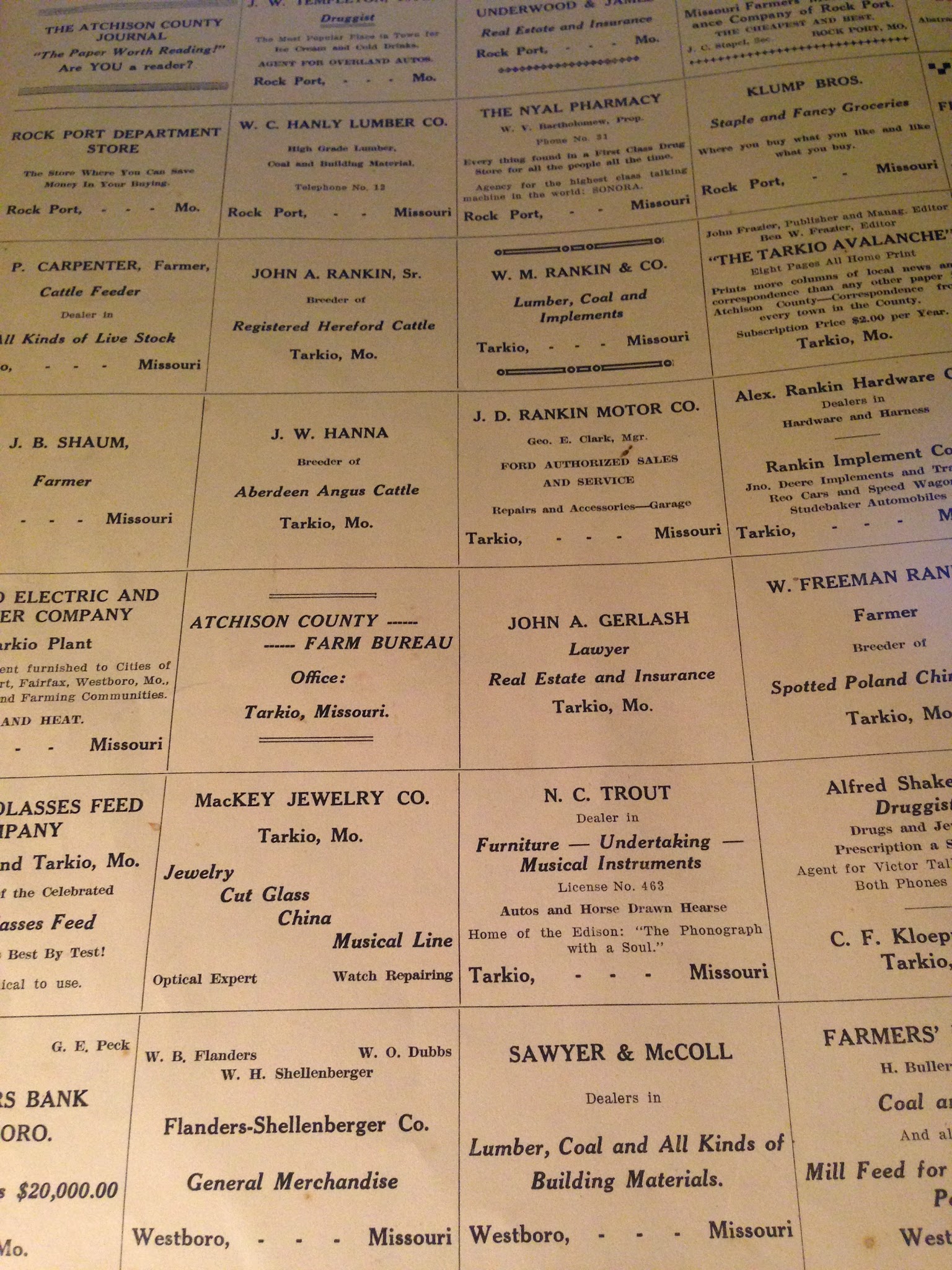
Farmsteads grow up and flourish, are absorbed or vanish; town centers migrate with the traffic patterns and schools consolidate, but while populations wax and wane, our cemeteries remain.
We honor those that came before: those who settled this country, built this country, fought for this country and ultimately came back to this ground to their earthly rest. Our cemeteries are beautiful places this time of year with the Stars and Stripes whipping in the wind and the peonies and irises in bloom. Our past is there...in all the names that seem familiar and the remembrances laid lovingly and dutifully alongside. But our future is there as well; for every tended cemetery is a mark of civilization and faith that our community will still be on the map in years to come.

Bado
A village in Morris Township. It was established during the Civil War (c. 1863) by Mr. Clabe Groce. The present (1933) postmaster has always lived within a mile of the office and has heard that it was so called because it was settled during the bad years. The name was used long before it became a post-office in 1888. (--Place Names.)
Bado was located at Section 34, Township 30 N, Range 11 W, on Highway M, south of Fairview, and north of YY.


Friday, October 31, 2014

All the World Loves a Parade

"to see the world in a grain of sand...." William Blake

"Carthage is a city in Jasper County, Missouri, United States. The population was 14,378 at the 2010 census. It is the county seat of Jasper County and is nicknamed "America's Maple Leaf City."


Bright and early Saturday morning, we find ourselves just west of the courthouse square in Carthage, Missouri. The sun has not yet risen behind the courthouse and the color guards and veterans' floats are in deep and chilly shadow. In front of us is a snazzy old Ford in up to date paint and behind us is the Cabool Marching band, warming up their horns, rocking some fanfares and showing more energy than I would expect considering how early they must have hit the road. Our hosts are putting the finishing touches on their float entries, taping up signs and filling the milk pails of candy that will soon be handed to importuning sweet tooths.
I get the lowdown on this event from one of the locals:

1) the parade will take two and one half hours start to finish.

2) there are more than 300 entries.

3) it always takes place this weekend in October, whether or not the Maple Leaves that are the erstwhile draw cooperate or not.

Then she takes me aside and in an act of infinite courtesy, asks if I'd like to walk over to the Post Office and use the restroom.

If you want a windshield survey of small town America, join a parade. Choose your basic components: a courthouse square, a color guard, a marching band, a grand marshal, a little miss and mister, elected officials and/or candidates more or less, church floats, school floats, local business floats.....and dance academies and emergency vehicles galore. Leaven your parade with any combination of Shriners' entertainment...I particularly enjoy the train, the bandwagon, and especially the calliope. The shortest parade I know of takes place close to home: two blocks south and two blocks west in length, but even it boasts riders of two wheeled and four legged saddles both.
Blake and I knew a vast quantity of sweets had been purchased for this grand event by the more than generous hosts of our float. We were prepared to tear our rotator cuffs to shreds heaving great clutches of candy to the multitudes waiting under the autumnal boughs along the parade route. What a disappointment it was to be admonished by the local authorities NOT to throw candy under any circumstances! The grandma in charge was quite serious about the trouble she might be in should any candy fall onto the ground through the course of the parade. No, the only way for the kids to get their treats was for the gallant young ladies in Official FFA dress to hand it out piecemeal while marching double time with a full 2 1/2 gallon milk bucket behind our pickup and the Farmall M of guests behind us. They made a valiant effort and I dearly hope they escaped without shin splints..
Waving at a crowd of folks you don't know....and who REALLY don't know you is awkward....but watching the parade route go by at 10 miles an hour is great. It was ever so tempting to keep my camera up to one eye for the entire ride, but I would have missed so much! With the accompaniment of the nearest band drifting to us on the breeze, the folks on the porches of the grandest mansions gathered with steaming mugs in hand, looking like nothing so much as small town college gentry. Indeed, there were signs of college allegiance throughout the parade route.....a virtual menagerie of Tigers and Gorillas and Bears..Jayhawks and Wildcats, too. The curbs were crowded with blankets, camp chairs, and strollers of well bundled babies.


As we neared the Middle school, the very first of the marching bands started straggling past us, headed in the opposite direction. We rode back to the beginning of the parade, followed by a convertible containing a tattooed biker, a guy in a University of Northern Iowa sweatshirt and two well coiffed members of the local theater group.
And this is what I love about small towns. If you had seen these four people individually on the streets of Carthage....and I did, before the parade....you would never have placed them in the same convertible after the parade. There is a story and one that might surprise folks that have decided rural people are as homogeneous and uninteresting as American cheese. Sure enough, the parade was still rounding the square when we returned to our starting point. Following the Shriners were the ghouls and ghosties promoting their particular Haunted Houses. Then a dance and rhythm group from Kansas City. Then a fellow with his septic tank pumper truck.....with a big pink ribbon on its side and a contribution for breast cancer with every job. A heart felt story in that one.


Finally, fitting as can be for a city on America's Route 66, there are fireworks...or at least a pickup shooting confetti! Big city, no...ticker tape, huh uh...but this heart of America celebration still left plenty for the street sweepers to work with....

Sunday, June 6, 2010

Wagons, Ho-ohhhhh!

The storms of June following the constant rains of May have left our country roads in quite a state. You can mess up the alignment of your minivan dropping off the pavement to the erstwhile gravel road. Your four wheel drive independent suspension will loosen your false teeth on the washboards of the downhill slopes. Even the most seasoned skier would have a difficult time navigating the moguls at the top of the rises. A driver plays Russian roulette where the tubes have washed out and the road narrows to one car wide. On my way to work this morning, 160th, the gravel leading to the greenhouse, reminds me of nothing so much as the Oregon trail ruts carved deep into the limestone at Guernsey, Wyoming. And thinking of the Oregon trail.....

Like many of us, I've visited our nation's Capitol and viewed with reverence and respect the memorials and monuments to our nation's founding and history. Each and every time I mount the steps to the Lincoln Memorial, I get goosebumps reading the words of the Second Inaugural Address on the marble wall. However strenuous the gauntlet of security surrounding the Capitol, it is still the people's house. The walls, the intricately tiled floors, the murals, the well worn desks: despite the uniformed attendants and bustling, over busy factotums , the subtext of the surroundings is " you have every right to feel at home here." The streets fill every morning with the worker bees of the government, but the city belongs to the tourists. In Washington, D.C., our history is concentrated, piled up like a seven layer salad. And like that dish, mixing the ingredients may ruin the appearance, but improves the experience. That's how I feel eating lunch at the Old Ebbitts Grill: new seating in the enclosed atrium, old style wait staff, antique bar. Or visiting the American Art Museum/Portrait Gallery nee' Patent Building. Or perusing the book I have from the National Archives titled 'Washington old and new'.
But wait. Washington, D.C. is not the whole story. The story of America found on the Mall is the Readers Digest condensed version: it cannot do justice to the natural physical spaciousness and enormity of America and the way it formed the American character and experience. Instead of walking the National Mall of our east coast, one must hit the highways and follow those seekers on the Oregon Trail.
Maybe I put too much store in the pioneers. Perhaps this is a provincial prejudice of itself. After all, when you live just north of the home of the Pony Express, when you cross the proverbial Wide Missouri every little whip stitch, when Lewis and Clark's Indian tribes named your neighboring counties, when the flat sandy Platte empties nearby; how could you fail emphasize and honor the super highway of the last century?

Not just recognize, but also realize how many of the differences between the coasts in our present day derive from the differing perceptions of the scope and scale of our modern country. Those folks living at the end of the section roads in the Sand Hills are not newcomers; they have roots as deep as the grasses that hold the ancient dunes in place. You think Nebraska is long on I-80? The Oregon Trail covered even more miles on the wandering south side of the Platte; the Mormons kept themselves separate on the north side. I'm sure those 400 odd miles seemed long, but as the bountiful pasture and water of the east dwindled as the land rose and the humidity dropped, it could and did get worse. Think of those folks; never spent a season in a truly dry land. Never lived through searing winds of 40 mph day after day. Never saw the storms rise up from nothing over the horizon and drop hail the size of hen's eggs.
We've been to Ash Hollow and seen the broken land the dried and split wagons traversed. A sobering warm up for the slope of the Rockies. How bizarre did the monuments of Chimney Rock and Scotts Bluff appear? Or perhaps the travelers didn't mark this passage; unlike our windshield surveys on pavement, Chimney Rock and Scotts Bluff were landmarks for days on end.
Across the Platte in Wyoming, the rocks at Guernsey concentrate the impact of the wagon wheels. If you stand at the foot of the rocks, the ruts are four foot deep. The names of the travelers are carved in that same stone in block letters with dates attached. What a leap of faith or foolishness!!  Here in eastern Wyoming, the topography is moderate though the eastern forests and plentiful wood are but a distant memory.
The next stop for weary travelers would be Fort Laramie, a gathering place for military, Indians, and emigrants. Fort Laramie looks much as it did 150 years ago: tremendously exposed, big sky, big prairie near a modest copse of cottonwoods. There is little to protect or screen the wooden enclave: the landscape is reduced to its lowest terms; you are in the West.
Even more evocative of the stark and brutal journey is the landscape farther west in Wyoming. The current highway following the Trail can be lonely in the 21st century; no towns exist for miles, though in classic Wyoming fashion, the widest spot of the road gets large font on the state map. The terrain is broken, the names foreboding: Rattlesnake Hills, Devil's Gate. Independence Rock sits in the middle of this landscape, imposing and graffiti-ed. We arrived at Independence Rock one morning when the shadows were still long. The parking lot was empty and the air silent. Unlike a midwestern summer morning, there was no bird song and no dew, just the crunching of our footsteps on the path. For miles past Casper, we'd seen no sign of human habitation or occupation except the signs for the Pathfinder ranch. The Rattlesnake Hills were black and barren. The highway both directions was empty. It was not hard to imagine how endless the miles would seem when laboring through this desolation.
For the modern traveler, it is but a short drive on to the Devil's Gate, a gash in the rocks before the welcoming meadows and water of the Sweetwater River. But the wagons and teams would take an entire day to make the distance, a pace that became even more labored as the summer wore on, the days shortened and the mountains loomed.

I can hardly imagine what drove those people to travel such a distance. These were wanderers, drifters, dreamers and the children of such restless folk uprooted from their native soils. They took leaps of ignorance and faith and could never have known how ill prepared their best efforts were. Was Oregon or California really worth this sacrifice? Apparently so, because the prairies still bear markings from the impact of the exodus even today. Where are those doughty long suffering souls today? They are still in our bones and in our pretty well universal can-do approach to circumstances. Every time we pack up our families and belongings and take on a change of life and location, we pay homage to our forebears. We may not recognize ourselves in the marbled halls of our seat of government. But when we drive the thousand miles from the Missouri River to the Devil's Gate, we do. We are far removed in time from the emigrants of the Oregon Trail, but we admire their persistence, their spirit, and their hope for a better life for their loved ones.

Monday, May 24, 2010

Batter up !!


They swing; they miss. They pound the plate; they corkscrew into the dust around home plate. They are so anxious, they nearly clock their coach while he is adjusting their hands on the bat. They slide into first, slide into second, run through the stop sign from the third base coach and tippy-toe to home plate to avoid the next batter who is also over enthusiastic and has snuck up to the plate. The happy runner stomps on home with both feet.

In the field, they watch the ball. Most of the time. Sometimes one's hat must be adjusted. Sometimes a teammate's stance just looks so good that it must be emulated. Sometimes, inexplicably, there is some action beyond the game that must be observed, even if it means turning one's back on the plate. Sometimes an at bat takes just a pitch or so too long and the 'ey batta stance becomes a squat in the dust of the infield.

This is t ball II and it is in the best tradition of so many facets of sports and summer. Its local; around here, that still means a pretty good hike between games, but nothing beyond the next county. Its casual; the early arrivals park close enough to sit in their cars, but most of us pull out camp chairs and water jugs and cheer from any shady spot on the sideline. Its relaxed; younger kids clamber up the bleachers or roll down the slope. 


 The players know the final score; the adults have no idea. Everyone plays, everyone bats, the dads pitch and the games end after three innings or one hour. Each inning last three outs or five runs. Guess which outcome is most likely? Hence casual; hence relaxed. It will all be over before anyone gets too tired, too sunburned, or even too thirsty. Though some of the senior members of the crowd leave because it is suppertime.

Aaron and Gus are our family representatives on the Tarkio team. Aaron has played exactly one year of ball. And notice I didn't qualify that year as "organized" ball. Gus is an old hand; he wears Albert Pujols' number 5 and sports a massive Jim Edmonds' uppercut swing. When he connects, the ball goes a long ways. I can see Aaron linking cause and effect: Gus pounds the plate, Gus hits a home run. Next time up, Aaron pounds the plate too.

This game, the fans can actually keep track of which team is ahead. One inning, the little Mound City kids hit three ground balls to the Tarkio pitcher. He tosses the ball over to first before the runners cross the plate. Its not a three up, three down inning, but a three out inning may not occur at this level of play for the rest of the season. When Tarkio heads to the dugout after their last at bat, whoops of excitement roll across the field before the boys file out and slap hands and chant 'good game'. The kids have a "win" under their belts to brag about amongst themselves and recap to any family not in attendance.

Sure enough, my phone rings about 10 minutes after we get home. Its Aaron and he's telling me "We won! 14 to 5!" Then he asks me if I heard them yelling in the dugout. 'Yes, I did,' I say,' You should be excited to win your first game'.
'Do you think Mound City heard us?' he asks. 'I don't know, Aaron. They were probably listening to their coaches talk about the game.' 'Well, I didn't want their feelings to be hurt.'

I reassured him that it was OK to be happy with winning and their team had come out afterwards to meet and greet. But I saved that moment to tell his mommy and daddy later on. Its good to hit the pitch; its good to score a run, and maybe one of these days Aaron will also catch a ball or throw a runner out. But it only took one game to realize the guys in the other dugout are just like him and to live up to that age old saw:

'Its not how you win or lose, its how you play the game.'...

Or in this case, celebrate afterwards....